NEWS CENTER
How to Solve Level Measurement Interference in Severe Working Conditions: HCCK Instrument Selection and Anti-Interference Technical Guide
Huachuang measurement and control Huachuang measurement and Control Technology Co., Ltd 2026-10-27 16:48
1.What measurement disturbances and application pitfalls emerge in harsh industrial level measurement scenarios? From cement raw meal silos with heavy dust and constantly undulating material surfaces, high-temperature chemical reactors holding molten fluid at 1200℃, coated tanks prone to medium buildup, closed pressurized corrosion storage tanks, deep wells and wastewater basins vulnerable to sediment clogging, to tall solid silos with narrow internal space and river channels for hydrological monitoring, each working condition imposes unique interference on level sensors. Traditional level instruments frequently encounter a set of recurring failures. For radar gauges, dense dust, steam, material bridging and tank internal fittings will generate false echoes and distort echo signals, resulting in jumping or unstable readings. RF admittance and capacitance switches easily lose validity once sticky coating materials accumulate on the probe surface. Submersible hydrostatic transmitters face sediment deposition, suction port blockage and corrosion in sewage and underground water environments. Double-flange differential pressure solutions are sensitive to gas-phase pressure fluctuation inside sealed tanks, and improper installation will introduce large systematic deviation. Besides, many users adopt a one-type-fits-all instrument selection method without matching antenna structure, isolation material, pressure resistance grade and anti-blocking design to actual medium features. Blind selection leads to frequent maintenance, unplanned shutdown and unreliable inventory data, which cannot satisfy continuous safe production.
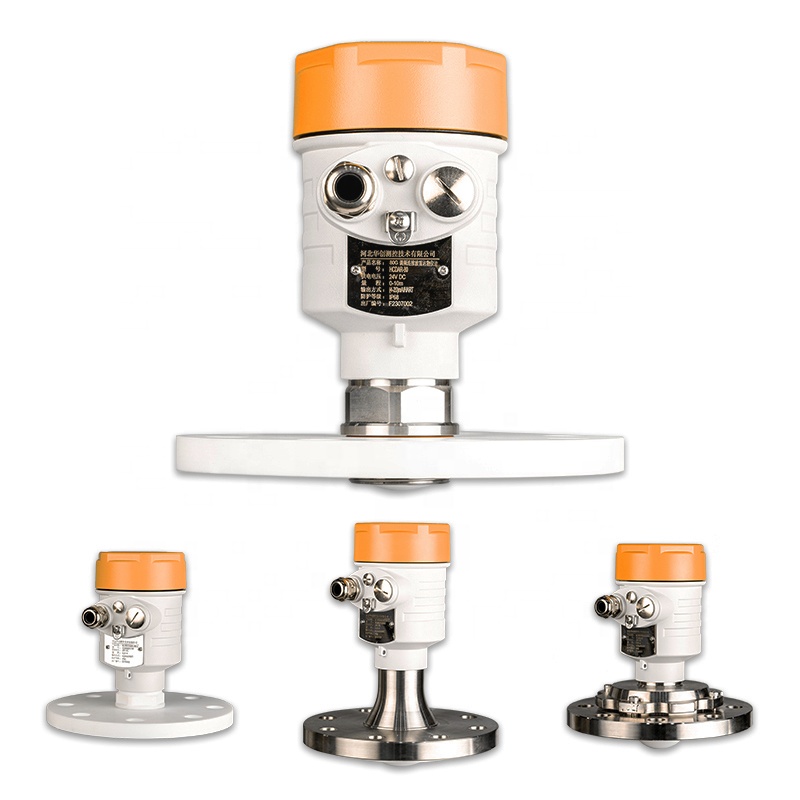
2.HCCK full-spectrum level & pressure instrument portfolio, core principle and anti-interference design To solve measurement pain points under diverse severe working conditions, HCCK provides a complete series of level and pressure transmitters covering mainstream measurement technologies. The 80GHz FMCW narrow-beam radar level transmitter adopts focused high-frequency electromagnetic wave. It supports quartz isolation structure for ultra-high temperature molten medium, multiple antenna options including horn antenna and parabolic antenna. It restrains false echoes through built-in echo curve mapping algorithm, adapting to cement silos, tall solid bins, corrosive and pressurized liquid tanks. RF admittance anti-buildup level switch eliminates the influence of material adhesion by active capacitance compensation, which is specially developed for coating, sticky slurry and viscous medium point-level alarm. Submersible hydrostatic level transmitter comes with customized anti-clogging protective cover and anti-corrosion housing, designed for wastewater pools, deep wells and river hydrological monitoring. Double-flange remote differential pressure transmitter accurately deducts the gas pressure inside closed vessels, delivering stable liquid level value for pressurized sealed tanks. Pressure transmitters for pipelines and vessels cover multiple accuracy grades and overpressure protection structures, used for auxiliary pressure monitoring and liquid level conversion. Every instrument reserves standard Modbus signal output, and can seamlessly connect to the HCCK Industrial IoT Cloud Platform for centralized remote monitoring, alarm push and data archiving. We separate contact and non-contact measuring paths, match wear-resistant, PTFE, quartz and Hastelloy wetted materials on demand, and support explosion-proof and intrinsically safe certification for hazardous zones.
3.Site selection workflow and core evaluation parameters Before instrument configuration, HCCK application engineers will sort out site conditions step by step to avoid mis-selection. The core evaluation items include medium properties: solid powder / granular / liquid, viscosity, dielectric constant, coating tendency, temperature and pressure range, corrosive composition. Environment conditions: dust concentration, steam, foam, open water flow or confined vessel, explosion risk zone. Measurement target: continuous level tracking or high/low point alarm, measuring range and required precision. Installation boundary: nozzle size, internal obstacles, tank lining, available mounting height. After instrument commissioning, echo mapping, threshold filtering, damping parameter adjustment and alarm threshold setting are required to suppress fluctuating signals. If remote digital management is needed, we will match DTU or LoRa gateway, complete network layout and cloud dashboard configuration together with the sensing instruments.
For professional support, visit our Website at http://www.hhcck.cn/ , contact our team via WhatsApp: +86 150 2761 6330, or Email: sales@hhcck.com.


South of Puhui Street, west of Guangsheng East Road, High tech Zone, Fengnan District, Tangshan City, Hebei Province





Technical support:

Tips
Submitted successfully
Back Index