NEWS CENTER
How to Achieve Centralized Remote Level Monitoring for Distributed Tanks and Silos: HCCK Industrial IoT Cloud Platform Solution
Huachuang measurement and control Huachuang measurement and Control Technology Co., Ltd 2026-10-23 09:38
Across petrochemical tank farms, municipal water distribution networks, grain storage logistics hubs, modern dairy feed silo clusters, power plant flue gas desulfurization facilities, and decentralized industrial wastewater treatment basins, storage vessels present distinct operational characteristics: wide geographical distribution, large vessel quantities, and hostile field environments. Under conventional management models, industrial enterprises encounter severe visibility blind spots and operational bottlenecks. First, fragmented "data silos" remain widespread; radar level gauges, pressure transmitters, and ultrasonic level sensors installed across scattered tanks typically provide only local gauge readings or feed isolated single-machine PLC control panels, preventing real-time data sharing across central enterprise control rooms, production dispatchers, and management teams. Second, manual inspection routines incur exorbitant labor costs and expose personnel to severe safety hazards; technicians must frequently climb tall vertical tanks or enter hazardous explosion-proof areas for manual log entries, which is prone to reporting latency and errors while posing critical fall and toxic gas inhalation risks. Furthermore, traditional monitoring setups lack multi-channel proactive alerting; in the event of pipeline ruptures, tank overfills, silo bridging blockages, or sensor communication dropouts, local audio-visual alarms fail to notify off-site personnel instantly, risking catastrophic material loss and environmental incidents. Meanwhile, building bespoke on-premise SCADA systems requires extensive engineering cycles, high development costs, and complex protocol drivers, with poor mobile compatibility.
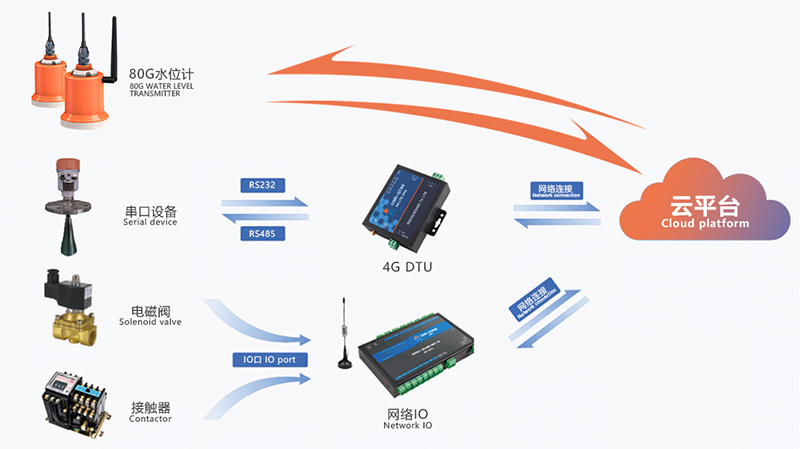
To satisfy the urgent demand for real-time asset transparency, industrial enterprises require an industrial Internet of Things (IoT) cloud monitoring solution that is plug-and-play, lightweight, protocol-agnostic, multi-terminal synchronized, and equipped with powerful SCADA graphics and intelligent alerting. This engineering solution must bridge field instrumentation with cloud analytics while ensuring high-reliability local edge interlocks and flexible mobile operational access.
To eliminate field data silos and achieve end-to-end intelligent visual management, HCCK delivers the integrated "HCCK Industrial IoT Cloud Platform and On-site Centralized Management System" solution. At the physical sensing and data acquisition layer, the system leverages 4G DTUs, LoRa wireless modules, LoRa 4G gateways, PLCNET 500 Ethernet/serial PLC converters, and network IO modules to natively support RS485, RS232, Modbus-RTU/TCP, digital IO, and custom industrial protocols. This enables plug-and-play data ingestion from HCCK high-frequency radar level transmitters, ultrasonic level sensors, pressure transmitters, digital control valves, contactors, and third-party PLCs within seconds. On the local operational side, custom on-site centralized management consoles comprising industrial PLCs, HMI touchscreens, data acquisition modules, and redundant power supplies provide animated, real-time process mimics, ensuring autonomous local fail-safe interlocks and operational continuity.
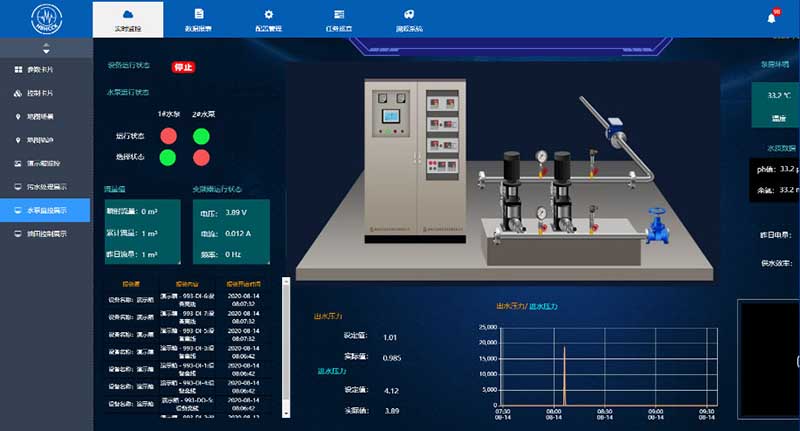
At the cloud analytics and presentation layer, the HCCK cloud platform utilizes an advanced B/S architecture supporting seamless access across PC web browsers, mobile iOS/Android apps, and WeChat mini-programs. Featuring over 40 functional modules and hundreds of configurable UI widgets, operators can rapidly assemble tailored monitoring dashboards without coding. The cloud platform delivers five comprehensive functional systems:
Monitoring & Visualization: Integrates GIS geographic mapping (displaying multi-site project locations and coordinates), drag-and-drop graphic SCADA mimics (customizable 2D/3D animated process flows), live IP video camera integration, real-time parameter cards, and multi-variable monitoring lists;
Logic Control: Supports authorized remote start/stop operations, numeric setpoint adjustments, automated timer-based sequential control, and inter-device cross-node interlocking;
Alerting & Alarm Dispatch: Configures multi-tier thresholds for high/low level limits, pipeline leakage detection, temperature anomalies, and communication loss, automatically broadcasting instant alerts via SMS, WeChat, automated voice calls, and email;
Data Reporting & Analytics: Automatically archives historical measurement trends, generating customizable time-series curves, bar graphs, pie charts, and compliance export spreadsheets to streamline inventory auditing and energy management;
Intelligent Enterprise Management: Provides hierarchical multi-tier organizational permissions, equipment lifecycle management, telemetry driver configuration, and digital inspection task tracking to drive operational efficiency.
To guarantee rapid deployment and long-term reliability across complex multi-site facilities, industrial IoT cloud implementations must adhere to strict network topology and electrical safety standards. In terms of communications topology: for isolated storage tanks or remote hydrological stations with reliable cellular coverage, direct-to-cloud 4G DTU configurations are recommended; for dense tank clusters or metal-shielded processing plants, a hybrid topology utilizing "low-power LoRa wireless local mesh + central 4G gateway" minimizes cellular SIM fees while ensuring deep signal penetration in hazardous areas; for plant areas already operating automated PLC racks, the non-intrusive PLCNET 500 gateway mirrors PLC register data without disrupting existing mission-critical control loops. In hazardous classified zones, all field transmitters and wireless transmitters must be isolated with certified intrinsic safety barriers and explosion-proof enclosures, with RF antennas fitted with coaxial lightning surge suppressors.
When consulting with HCCK digitalization specialists for tailored cloud platform and control system integration, industrial operators should provide the following baseline parameters:
Facility distribution and vessel inventory: Geographic site locations, total count of monitored tanks/silos/sumps, physical distances between monitoring nodes, and structural obstacles;
Instrumentation types and electrical interfaces: Models and specifications of existing or planned level sensors, pressure transmitters, and flowmeters, along with signal output formats (two-wire 4–20 mA, RS485 Modbus-RTU, dry relay contacts);
Field network coverage and utility power: Availability of commercial 4G cellular coverage, local industrial Ethernet accessibility, and field power configurations (220 VAC mains, central 24 VDC loops, or standalone solar-powered systems);
Process control logic and alarm workflow: Requirements for custom local HMI displays, remote reverse-control pump/valve automation logic, alarm dispatch contacts (SMS/WeChat recipient lists), and multi-tier user role permissions. HCCK digitalization engineers will configure an end-to-end hardware acquisition package, control panel schematics, and dedicated cloud SCADA dashboards to accelerate your plant's digital transformation.
For professional support, visit our Website at www.hhcck.cn/, contact our team via WhatsApp: +86 150 2761 6330, or Email: sales@hhcck.com.


South of Puhui Street, west of Guangsheng East Road, High tech Zone, Fengnan District, Tangshan City, Hebei Province





Technical support:

Tips
Submitted successfully
Back Index