NEWS CENTER
How to Reduce False Echoes When Using a 26GHz Radar Level Meter in a Dusty Silo
Huachuang measurement and control Huachuang measurement and Control Technology Co., Ltd 2026-09-14 10:22
In cement, mining, grain, feed, coal and building-material applications, powder or granular material can generate substantial dust during filling, discharge and pneumatic conveying. Dust clouds, vessel walls, stiffeners, ladders, supports, inlets and the material surface may all reflect radar energy. When an obstacle echo is stronger than or close to the true material-surface echo, the level display may jump, show a fixed false level, remain active in an empty silo or fail to fall promptly after discharge.
A false echo does not necessarily mean that the radar instrument has failed. Many problems result from a mismatch between the installation position and the internal structure. For example, if the instrument is installed above the inlet, the falling material may enter the measurement path directly. If it is installed at the center of the silo, the beam may hit internal supports. If it is too close to the wall, a wall echo may be identified as a material echo. If the measuring range does not leave enough clearance from the blind zone, the high-level area may not be identified reliably. Radar selection for a dusty environment should therefore consider frequency, antenna type, beam path, mounting distance and echo-analysis capability together.
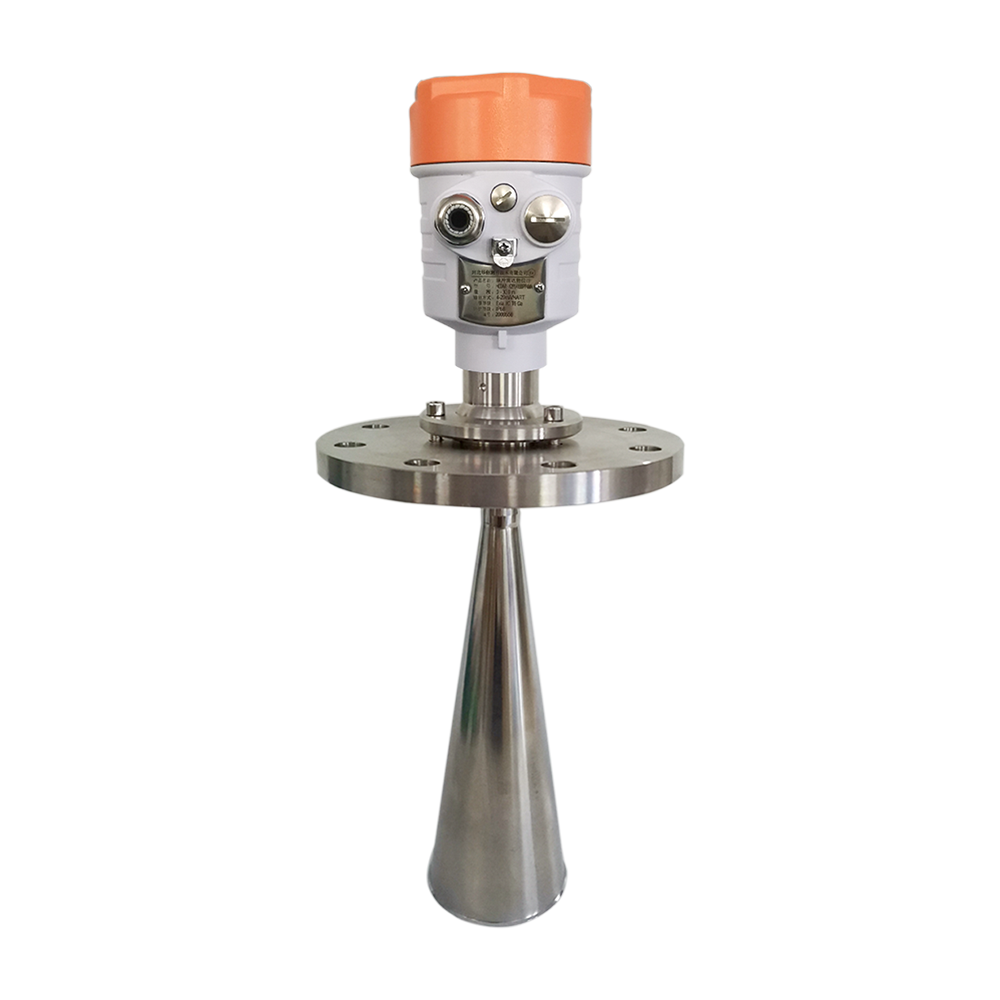
HCCK’s official HCDAR-63 page identifies it as a 26 GHz high-frequency radar level instrument for solid particles and powder. It provides 4–20mA/RS485 output and a maximum measuring distance of up to 70 m. The official information also states that the horn antenna has been optimized to support a purging function, that the microprocessor can perform higher-speed signal analysis and that a universal flange can be configured to adjust the angle according to the material pile angle for a better echo.
These official details correspond to several key selection questions in a dusty silo. For a high-dust process, confirm whether a purging structure is needed and whether a stable purge-air supply is available. If the material forms a clear pile angle, evaluate the antenna direction and the mounting angle available through a universal flange. For a tall silo, compare the actual empty distance, maximum level and effective measuring range with the stated maximum distance of 70 m; the maximum distance should not be treated as the effective range for every process condition. 4–20mA can be connected to common process-control systems, while RS485 can be used for digital communication. The exact interface configuration should be confirmed from the relevant product information and project requirements.
The installation position should first be kept away from the inlet and should not simply be placed at the center of the silo. HCCK’s official installation information recommends that the distance from the vessel wall to the mounting position should be at least one-sixth of the vessel diameter and not less than 400 mm. The instrument should also not directly face internal structures that may create strong reflections. Before installation, check the position of ladders, stiffeners, limit switches, heating equipment, supports and inlets, and confirm that the radar beam will not continuously hit these obstacles. If the silo has uneven filling or a material pile angle, a universal flange can be used to adjust the radar direction so that the echo is closer to the stable material surface.
During commissioning, enter the empty-silo height, full-silo height and relevant application parameters. Then observe the echoes during an empty condition, filling, a stable level and discharge. If the display shows a fixed level, check whether the distance corresponds to a fixed structure inside the silo. If the value changes rapidly during filling, determine whether the dust cloud or falling material has entered the measurement path. If the value remains unchanged after discharge, investigate buildup, the blind zone and echo selection. At high levels, the maximum material level must not enter the instrument blind zone. For materials with low dielectric properties or weak reflection, improve echo recognition through the correct antenna, mounting angle and application settings rather than simply extending the range.
In summary, 26 GHz radar selection for a dusty silo requires the product information and the installation conditions to be evaluated together. HCCK HCDAR-63 is specified for solid particles and powder, with official information including 4–20mA/RS485 output, a maximum measuring distance of up to 70 m, purging capability and a configurable universal flange. The final model, antenna, flange, purge method, mounting position and communication configuration should be confirmed according to the material properties, silo structure and HCCK’s latest official information.
For professional support, visit our Website at www.hhcck.cn/, contact our team via WhatsApp: +86 195 3225 4537, or Email: sales@hhcck.com.


South of Puhui Street, west of Guangsheng East Road, High tech Zone, Fengnan District, Tangshan City, Hebei Province





Technical support:

Tips
Submitted successfully
Back Index