NEWS CENTER
Level Is Not the Same as Inventory: How Millimeter-Wave 3D Scanning Overcomes the Limits of Point Measurement
Huachuang measurement and control Huachuang measurement and Control Technology Co., Ltd 2026-09-09 10:07
In cement, mining, coal, grain, feed, chemical raw material and building-material applications, the material surface inside a silo rarely remains perfectly uniform. Filling and discharge create different piling patterns. Powder may develop eccentric accumulation, ratholing, bridging or local voids, while granular material can form an uneven surface. A point level instrument normally provides the distance or level near one selected measurement point. That value may not represent the average level or the actual inventory distribution throughout the silo.
Point measurement remains useful. Radar and ultrasonic level instruments are widely used for process control, high- and low-level alarms and continuous monitoring. However, a single reading has limitations when the operator needs to understand the overall material distribution. The selected point may be located on a high or low area of the pile, or it may be affected by eccentric flow, bridging or a local empty zone. Estimating inventory from one height can therefore create a difference between the actual material profile and the value shown by the management system. Before selecting an instrument, the project team should distinguish between two objectives: controlling the level at one point, or understanding the overall material shape and inventory distribution in the silo.
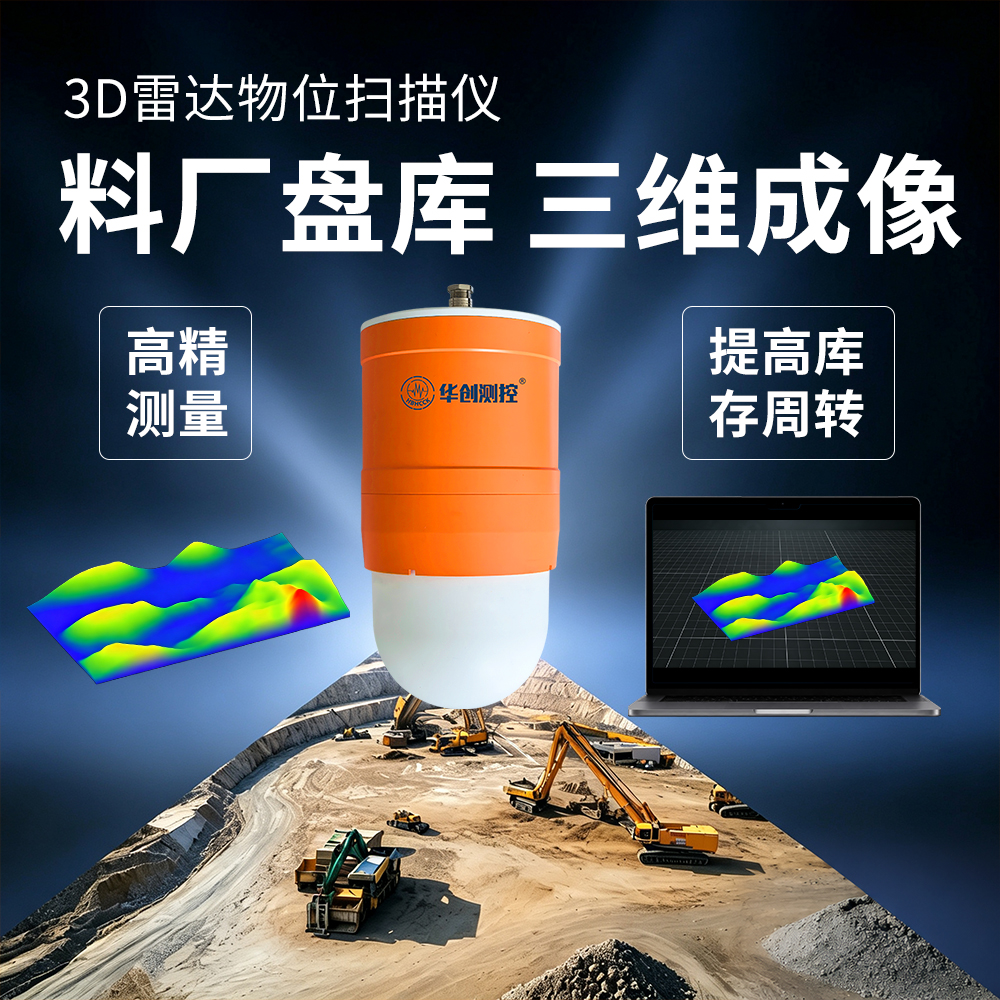
According to HCCK’s official HCDAR-3D product information, the system uses an internal mechanical structure to drive the radar sensor through horizontal 360-degree rotation and vertical tilting inside the silo. At different angles, the sensor transmits microwave signals. The signals are reflected by the material surface, and the system calculates the distance in each direction from the microwave travel time. By continuously changing the scanning angle, the system collects distance data from multiple directions and positions instead of measuring only one fixed point.
For data processing, HCCK’s official information states that the system combines the collected angles and distances with the installation position. It uses image processing, big-data analysis and machine-learning technologies to convert the data points into three-dimensional coordinates and create a 3D point-cloud model of the silo and material surface. Through visualization, operators can observe the highs, lows and overall shape of the material surface. The official page also states that the system can calculate material volume, weight or mass and average level from the 3D model.
The value of 3D scanning is therefore not simply obtaining one level value more quickly. It changes the measurement object from a single distance to the spatial distribution of the material surface. For uneven surfaces, significant eccentric accumulation, large silos or inventory-management applications, 3D scanning can provide richer spatial information than a single-point reading. The calculated result still needs to be interpreted together with silo geometry, material density and site calibration conditions. A calculated value should not be treated as an absolute inventory figure without considering the actual process conditions.
If the project mainly requires high- and low-level alarms, continuous process control or level change at one fixed point, a point radar level meter or another suitable level instrument may be the more direct solution. If the project requires information about eccentric material distribution, level differences between areas, inventory volume, average level or the shape of the material surface, a millimeter-wave 3D scanning solution should be evaluated. In particular, when a traditional point measurement cannot describe the overall inventory, or when manual stocktaking is costly or exposes personnel to risk, 3D visualization can provide more complete information for storage management and scheduling.
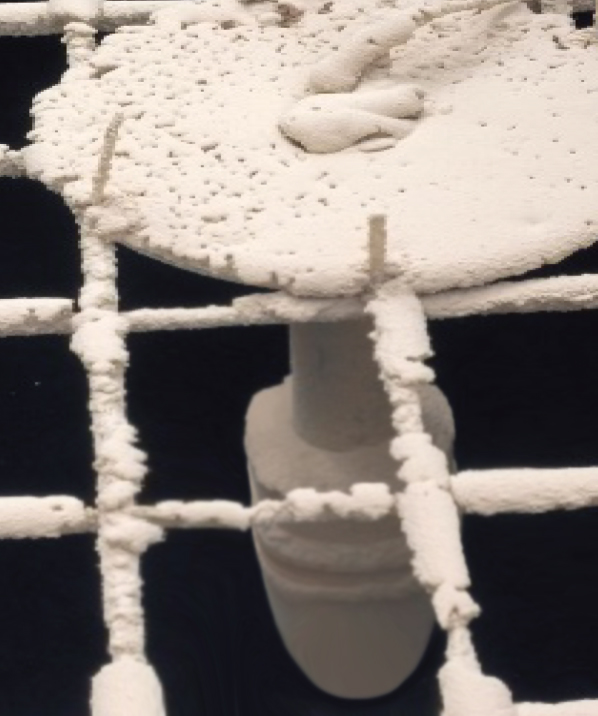
During selection, provide the silo height, diameter or structural dimensions, material name and form, filling and discharge method, dust conditions, internal obstacles, installation position and required management parameters. The project should also clarify whether it needs monitoring of one silo, networking of multiple silos or data exchange with an existing inventory-management system. HCCK’s official HCDAR-3D page presents 360-degree scanning, 3D visualization, equipment-software interconnection and AI algorithm functions. The final configuration, interfaces and implementation method must still be confirmed according to the actual site conditions and HCCK’s latest technical documentation.
A millimeter-wave 3D scanner is therefore not simply a replacement for every point level instrument. It is a measurement solution for applications that require overall material distribution and inventory information. For silo projects that need to move from point level management toward 3D inventory management, HCCK HCDAR-3D can be included in the technical evaluation so that the final solution matches the actual measurement objective.
For professional support, visit our Website at www.hhcck.cn/, contact our team via WhatsApp: +86 195 3225 4537, or Email: sales@hhcck.com.


South of Puhui Street, west of Guangsheng East Road, High tech Zone, Fengnan District, Tangshan City, Hebei Province





Technical support:

Tips
Submitted successfully
Back Index