NEWS CENTER
How to achieve the best performance of the radar level sensor? (1)
Huachuang measurement and control Huachuang measurement and Control Technology Co., Ltd 2026-03-19 11:27
Factors such as the radar frequency, antenna design, intelligent algorithms and installation location all play crucial roles in the successful measurement of the material level in tanks or silos. The more complex and precision-demanding the application conditions are, the more critical it becomes to obtain the optimal frequency and antenna design.
When used for material level measurement, radar can be classified into two types based on the measurement method: contact measurement and non-contact measurement. For contact measurement, the guided wave radar uses an emission frequency ranging from 0.5 to 1.8 GHz; for non-contact measurement, the free space radar transmitters typically use frequencies of 26 GHz and 80 GHz. Recently, there has been a lot of hype about high-frequency radar transmitters. Some companies claim that the higher the frequency, the better the performance. However, this is not necessarily true. Instead, accuracy depends on the frequency, beam angle, antenna configuration and installation, but the most important factor is the dielectric constant of the measured medium itself.
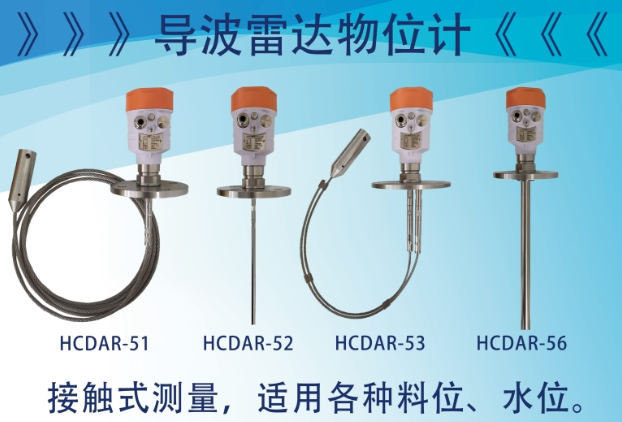
The free space radar transmitters have two main operating principles: Time of Flight (TOF) and Frequency Modulated Continuous Wave (FMCW). Each of them uses "time" as the basis for distance measurement, but the calculation methods are different.
1. Flight time, also known as Time of Flight (TOF) radar, uses microwave pulses emitted by the transmitter. When the microwave energy reaches the object being measured, changes in the dielectric constant (at the surface of liquids or solids) cause a change in impedance, and the microwave energy is reflected.
Microwaves travel at the speed of light. The radar detects the time it takes for the microwave pulse to reach the surface and return. The obtained time is divided by two to obtain the distance from the surface. By subtracting the distance measurement from the measurement range, the level of the material inside the tank or silo can be determined.
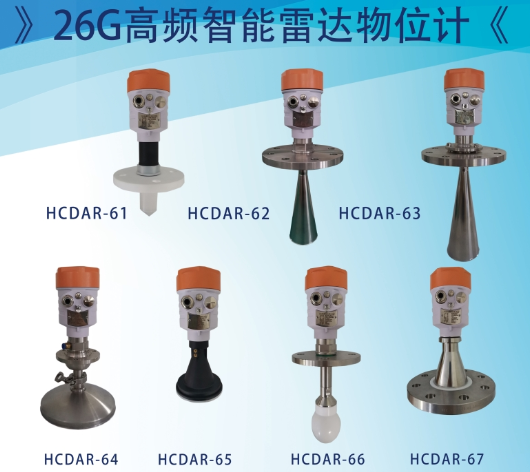
2. Frequency Modulated Continuous Wave (FMCW) radar also directs microwave energy onto the surface of the measured material. Like TOF radar, the reflected energy depends on the dielectric constant of the material. FMCW radar emits a continuous energy stream instead of pulses, and the frequency is continuously modulated or varies. For an 80 GHz (FMCW) radar, the frequency of the transmitter might start at 79 GHz and gradually increase to 81 GHz.
The transmitter compares the frequency reflected from the material surface with the frequency sent out. The difference in frequencies is equal to the time it takes for the microwave to reach the material surface and return. Just like a TOF radar, by subtracting the distance measurement from the measurement range, the applied level of the material can be obtained.
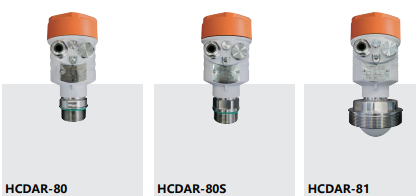
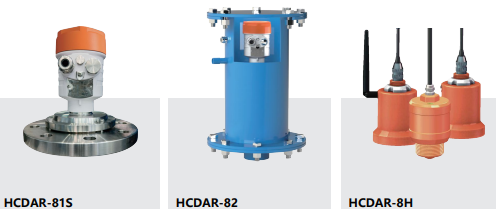
80GHz frequency-modulated continuous-wave radar
Although manufacturers cite various reasons to claim that one technology is better than another, in reality, the specific application details should be taken into account when choosing any of these technologies. Both of these technologies use microwave energy to transmit at the speed of light, and the reflection of the energy depends on the dielectric constant of the material being measured. Therefore, both methods determine distance or material level by measuring time.
Frequency effect
There are many factors that affect the accuracy and availability of the measurement signal, including frequency, antenna type, installation conditions and dielectric constant. The dielectric constant of the material being measured.
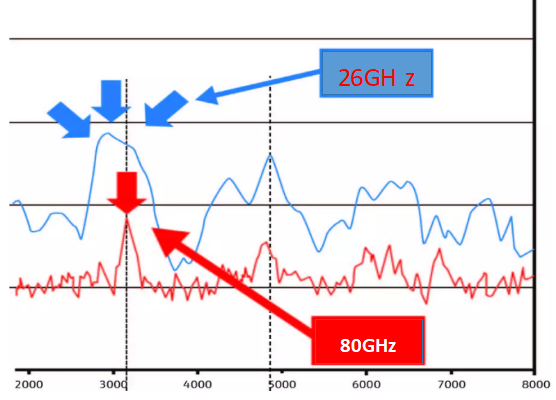
Figure 1: This figure compares the sharp peaks of the 80 GHz radar transmitter in the same complex application with the more rounded peaks of the 26 GHz radar reflector.
The frequency of the transmitter affects accuracy, beam angle and antenna size. Compared with higher-frequency transmitters, lower-frequency transmitters are generally less accurate because the signals generated by lower-frequency transmitters have poorer resolution. Figure 1 shows a comparison of the envelope curves between 26 GHz and 80 GHz radar transmitters. The pulses generated by the 80 GHz radar (red line) are approximately half the length of the 26 GHz pulses (blue line). This provides more accurate reflection and higher accuracy.
The 26 GHz pulse is much wider than the 80 GHz pulse. The transmitter decodes this pulse and determines the position of the material level. The blue arrow indicates that the pulse can be decoded at multiple points. The transmitter can decode the leading edge, the center, or the lower edge of the pulse as the material level, which will affect the accuracy. Since the 80 GHz transmitter pulse is sharper, this limits the decoding to one point, as shown by the red arrow. As a result, in process applications, the accuracy of the 26 GHz transmitter is usually 3 to 6 millimeters, while the 80 GHz transmitter can provide 1 to 2 millimeter accuracy.
Advanced algorithms can be applied to tank volume measurement with an accuracy requirement of less than 1 millimeter. The wave peaks reflected by the 80 GHz radar are also quite sharp, which makes accurate measurement of the material level relatively easier. With the 80 GHz process radar, the measurement accuracy in application can reach the millimeter level. The accuracy of tank volume measurement and custody transfer radar using 80 GHz is less than 1 millimeter. The frequency also affects the beam angle of the transmitter signal propagation. Lower-frequency transmitters produce a wider beam angle than higher-frequency transmitters. In some applications, a wide beam angle may be more suitable than a narrow beam angle.
If you have any needs, please contact us!
Contact number: 400-851-0898


South of Puhui Street, west of Guangsheng East Road, High tech Zone, Fengnan District, Tangshan City, Hebei Province





Technical support:

Tips
Submitted successfully
Back Index