NEWS CENTER
Why Do Ultrasonic Level Transmitters Produce False Echoes in Domed Tanks?
Huachuang measurement and control Huachuang measurement and Control Technology Co., Ltd 2026-09-07 17:31
An ultrasonic level transmitter sends an ultrasonic pulse toward the medium surface and receives the reflected echo. The instrument calculates the distance between the probe and the surface from the travel time, then converts the distance into a level value. According to HCCK’s official product information, an ultrasonic level instrument emits sound waves above 20 kHz, receives the echo reflected by the measured object and calculates distance from the time between transmission and reception. A clear and stable echo path is therefore essential for reliable measurement.
A domed tank has a curved roof. When the probe is installed at the centre of the roof, or at another position where the curved surface creates strong reflection and focusing, the received signal may not come entirely from the actual liquid surface. Part of the signal can be reflected by the roof, tank wall, reinforcing members, inlet pipes or other internal structures. These reflected signals may overlap with the true surface echo and appear as level jumps, unstable readings, abnormal values at low level or a fixed false level selected by the instrument.
This type of problem does not necessarily mean that the transmitter is damaged. In many field applications, the first cause to investigate is the installation point and the acoustic path. Domed tanks, vessels with internal structures and tanks with strong filling disturbance should all be assessed during instrument selection rather than only after unstable measurement has occurred.
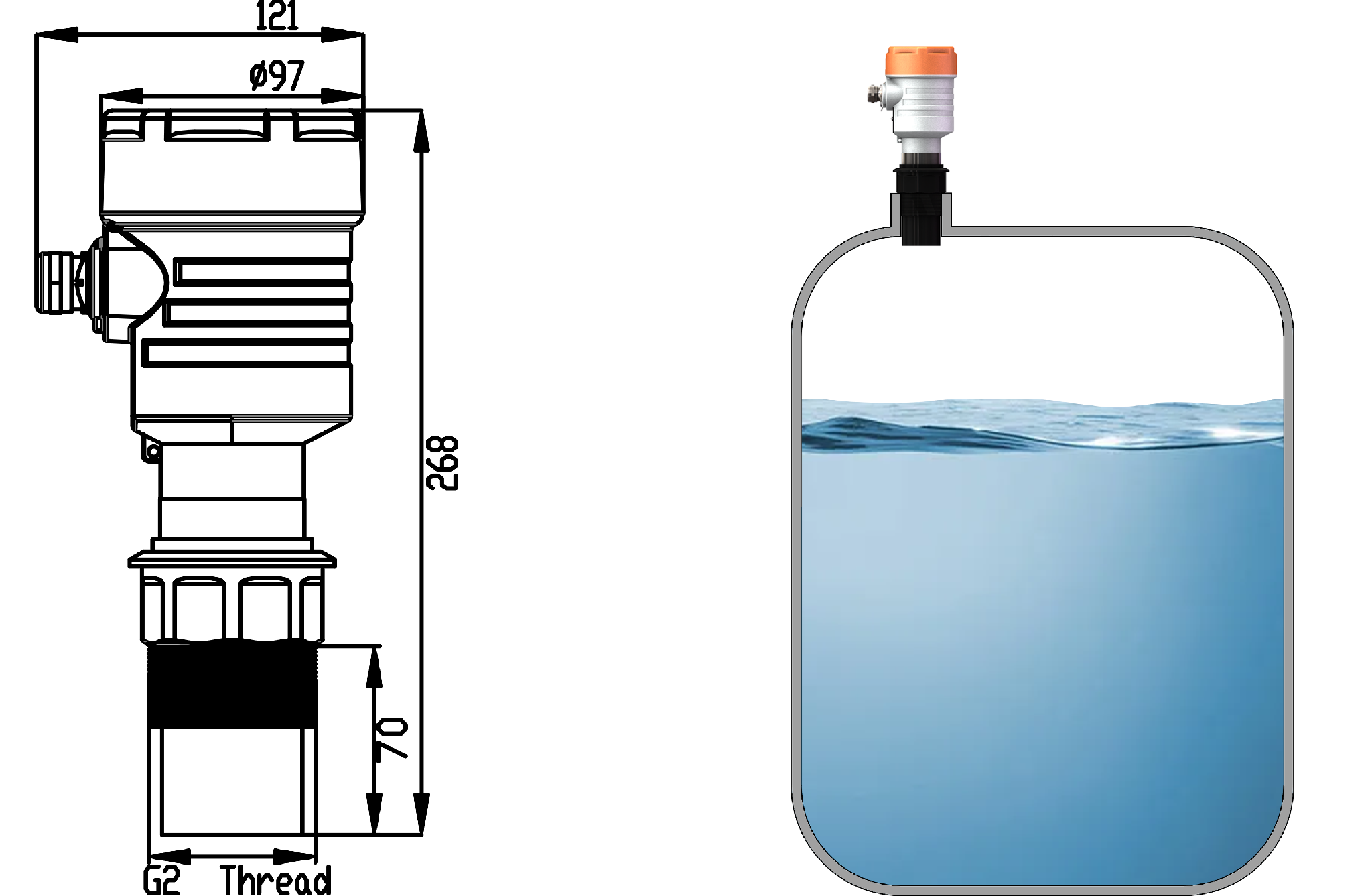
HCCK’s official ultrasonic level measurement information states that, for a domed tank, the instrument should preferably not be installed at the centre of the tank roof. A position around one-half or two-thirds of the tank-roof radius should be considered, while maintaining a suitable distance from the tank wall. The official explanation compares the domed roof to a convex lens: when the probe is positioned near a focusing point, it may receive a large number of false echoes. The probe should therefore be installed so that the acoustic path avoids the curved roof, tank wall and internal obstacles as far as possible.
The relationship between the probe face and the medium surface must also be checked. The probe should be installed as vertically as possible so that the acoustic pulse can travel toward the surface and return along a stable path. The mounting nozzle or extension pipe should not be unnecessarily long, and its inner wall should not block or strongly reflect the acoustic beam. HCCK’s official installation drawing shows a nozzle-height reference of less than 60 mm. The actual project still needs to be checked against the product structure, nozzle dimensions and mechanical conditions. Inlet pipes, agitators, heating coils, ladders and internal supports should be included in the acoustic-path review. The probe should not be placed directly above a strong reflector or a severely disturbed liquid surface.
Foam, steam, dust and continuous surface movement can further change ultrasonic propagation conditions. HCCK describes its ultrasonic level instruments as non-contact measuring devices for liquids, slurries and certain solid applications, and lists functions such as automatic power adjustment, gain control and temperature compensation. These functions do not replace correct installation, and they do not mean that the instrument is immune to every complex condition. When steam is dense, foam is thick or the echo is weak, radar level measurement should also be evaluated as an alternative technology during selection.
Before selecting the instrument, define the medium, tank shape, tank height, normal level, maximum level, minimum level, nozzle dimensions, internal structures and temperature changes. The output signal must then be matched with the control system. HCCK’s official information lists high-precision 4–20 mA current output, RS485 digital communication and programmable relay output for its ultrasonic level products. The HCUS-200 product page also states that the model supports mobile-app Bluetooth commissioning and RS485 MODBUS RTU output. If the project requires remote data acquisition, alarms or PLC integration, the required signal and communication method should be confirmed before ordering.
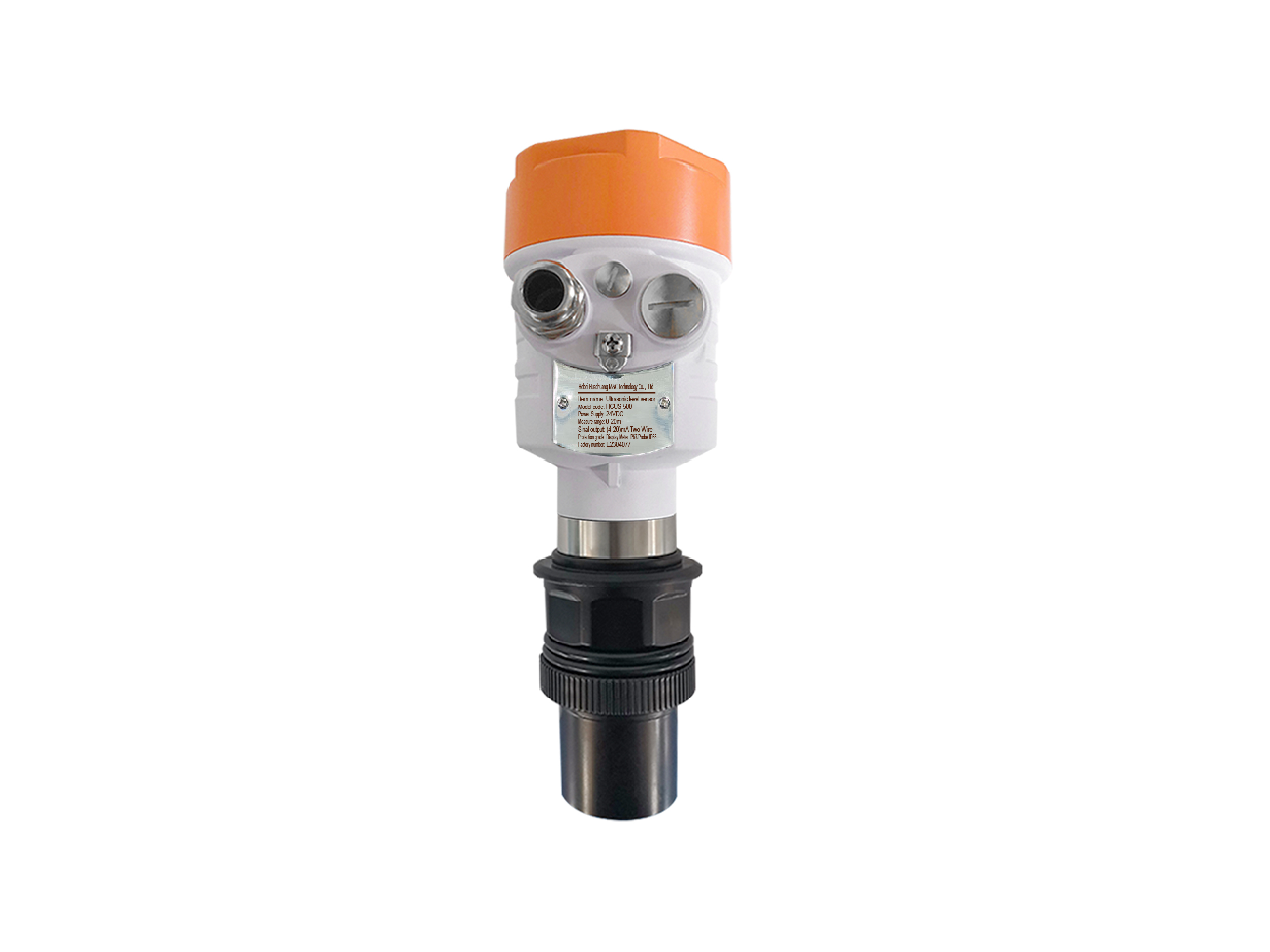
Commissioning should not rely on one instantaneous level reading. The signal should be observed at different conditions, including an empty tank, low level, normal level and filling operation. The displayed value should be compared with a reliable field reference, while the effects of filling, agitation, foam and steam are recorded. If an abnormal echo consistently appears at a fixed distance, inspect the roof, nozzle and internal structures first. If the problem only occurs during filling or agitation, focus on surface disturbance and the acoustic path.
Reliable ultrasonic measurement in a domed tank is therefore not simply a matter of mounting an instrument on the roof. It requires coordinated consideration of installation position, acoustic path, process conditions and output-system compatibility. HCCK ultrasonic level instruments can be considered for liquid, slurry and related level measurement projects. The final model and configuration should be confirmed according to the actual field conditions and HCCK’s latest technical documentation.
For professional support, visit our Website at www.hhcck.cn/, contact our team via WhatsApp: +86 195 3225 4537, or Email: sales@hhcck.com.


South of Puhui Street, west of Guangsheng East Road, High tech Zone, Fengnan District, Tangshan City, Hebei Province





Technical support:

Tips
Submitted successfully
Back Index