NEWS CENTER
What is HART Communication
Huachuang measurement and control Huachuang measurement and Control Technology Co., Ltd 2026-08-14 08:31
1. Basic Definition of HART Communication
HART stands for Highway Addressable Remote Transducer. It is the most widely used analog-plus-digital hybrid bidirectional communication protocol in industrial automation, primarily compatible with 4–20 mA field instruments such as pressure, temperature, flow and level transmitters.
Unlike pure analog or pure digital communication protocols, the core advantage of HART lies in its compatibility with traditional analog loops. It requires no modification to existing wiring systems and enables dual functions over a single cable, making it the dominant communication method for installed base instruments in factories to date.
2. Core Working Principle of HART Communication
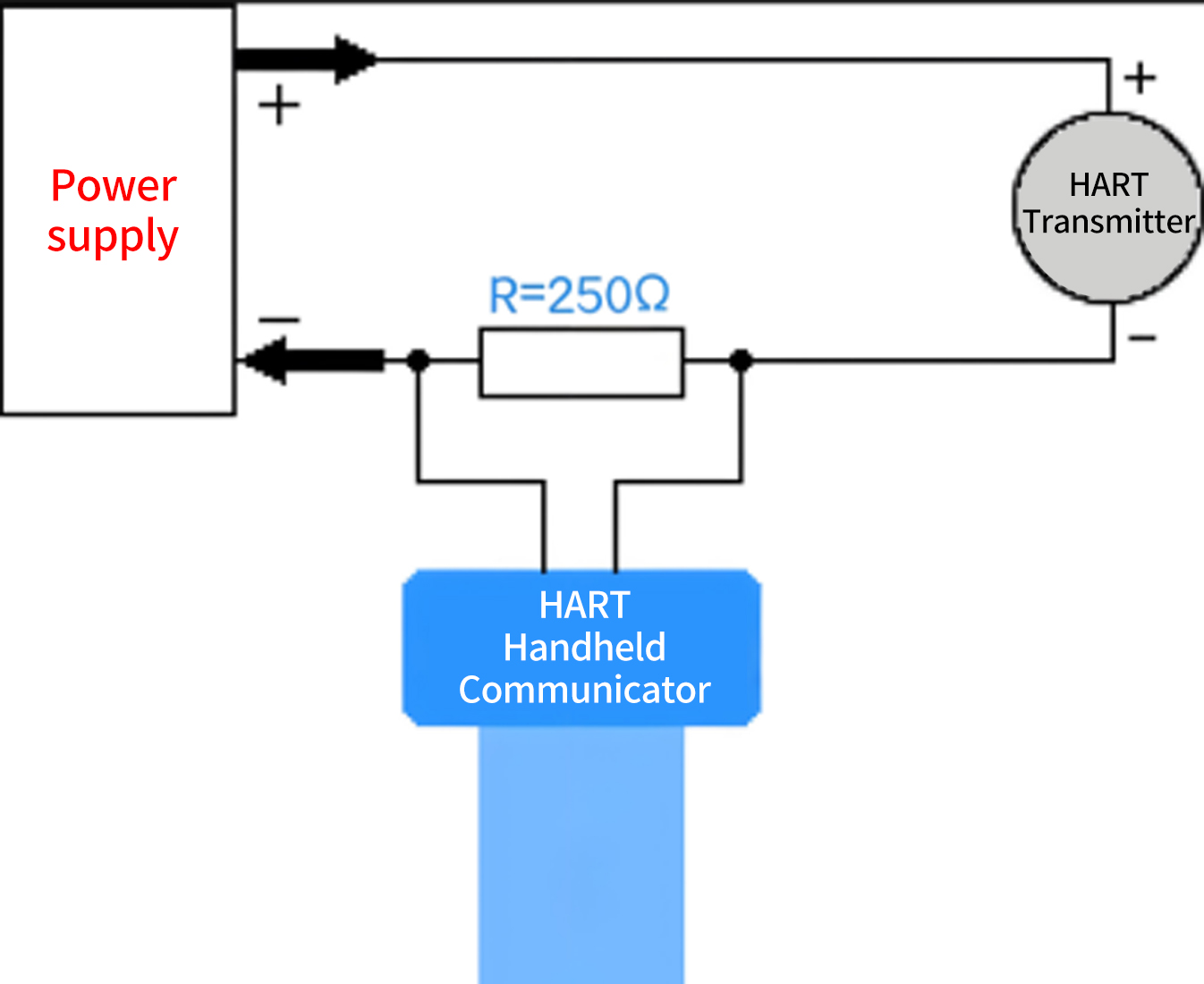
HART adopts Frequency Shift Keying (FSK) technology, which superimposes high-frequency, low-amplitude AC digital signals onto standard 4–20 mA DC analog current signals.
The average value of the superimposed AC signal is zero, so it does not alter the original 4–20 mA DC current in the loop. This ensures PLC and DCS systems can still accurately read measured values from field instruments, separating analog measurement and digital communication without mutual interference.
Non-HART instrument: Standard 4–20 mA analog output only
HART-enabled instrument: 4–20 mA analog signal superimposed with HART digital communication, equipped with dedicated HART chip and firmware on hardware.
3. Two Core Functions of HART Communication
4–20 mA Analog Transmission
It maps fixed physical field measurements to current signals. For example, a measuring range of 0–1.6 MPa corresponds to a standard 4–20 mA current signal. It transmits real-time precise process data to control systems to guarantee stable automatic equipment operation.
Digital Signal Communication
Via the superimposed high-frequency digital signals, remote configuration and commissioning of instruments are available. Users can read and write parameters including instrument range, engineering unit, device address, fault alarms, serial numbers and operational diagnostic data. No on-site disassembly or calibration is required, greatly improving maintenance efficiency.
4. Two Common Operating Modes of HART Communication
Point-to-Point Mode (Most Widely Used in Engineering)
Only one HART instrument is connected to a single loop. The 4–20 mA current carries process measurement data while HART digital communication runs simultaneously. This mode applies to most standard instruments on production lines.
Multi-drop Mode
Multiple HART instruments can be wired on one single loop. The loop current is fixed at 4 mA, and process data as well as device parameters are transmitted entirely via HART digital signals instead of the 4–20 mA analog signal. This drastically cuts field wiring costs and is mainly applied to monitoring instruments that do not participate in closed-loop control.
5. Hardware Characteristics of HART Communication
Most two-wire HART instruments feature simplified wiring: a single pair of cables provides three functions simultaneously — instrument power supply, 4–20 mA signal transmission and HART digital communication, delivering outstanding compatibility with industrial control systems.
6. Functional Differences & Application Scenarios
1. Functional Comparison
Non-HART instruments: Only 4–20 mA output supported; range adjustment and zero calibration must be completed on-site via physical buttons or potentiometers; no built-in device diagnostic functions.
HART-enabled instruments: Operators can remotely adjust range, damping value and engineering units via handheld communicators or computers; retrieve device ID, fault alarms, process temperature and multiple process variables. On-site opening and commissioning are unnecessary, ideal for mass maintenance in chemical and power plants.
2. Application Scenario Selection
Choose HART-enabled instruments: Chemical, petrochemical and power plants with large quantities of instruments, requiring remote configuration, fault diagnosis and heavy long-term maintenance workloads.
Choose non-HART instruments: Simple working conditions with limited measuring points, convenient on-site access for physical button operation, tight budgets and no demand for remote maintenance.
Our company’s HART-enabled products include radar level transmitters, ultrasonic level transmitters and pressure transmitters.
If you have any needs, please contact us!
Contact number: 19931378277


South of Puhui Street, west of Guangsheng East Road, High tech Zone, Fengnan District, Tangshan City, Hebei Province





Technical support:

Tips
Submitted successfully
Back Index